
ADC Practical Exam Day: Exactly What Happens, Hour by Hour

After every examination period, I debrief candidates on how their exam went. And the thing they say most often is not about a task or a scenario. It is some version of: “I wish I had known what the day would actually feel like.”
Not the syllabus. The day. The registration queue, the task list in your hands, the sound of thirty handpieces starting at once, the roleplayer who does not react the way you rehearsed.
The ADC’s practical examination handbook — available at adc.org.au — is the authoritative source for the exam’s structure and rules, and you should read it twice. What the handbook cannot give you is the candidate’s-eye view. That is what this article is for.
Two days, two different exams
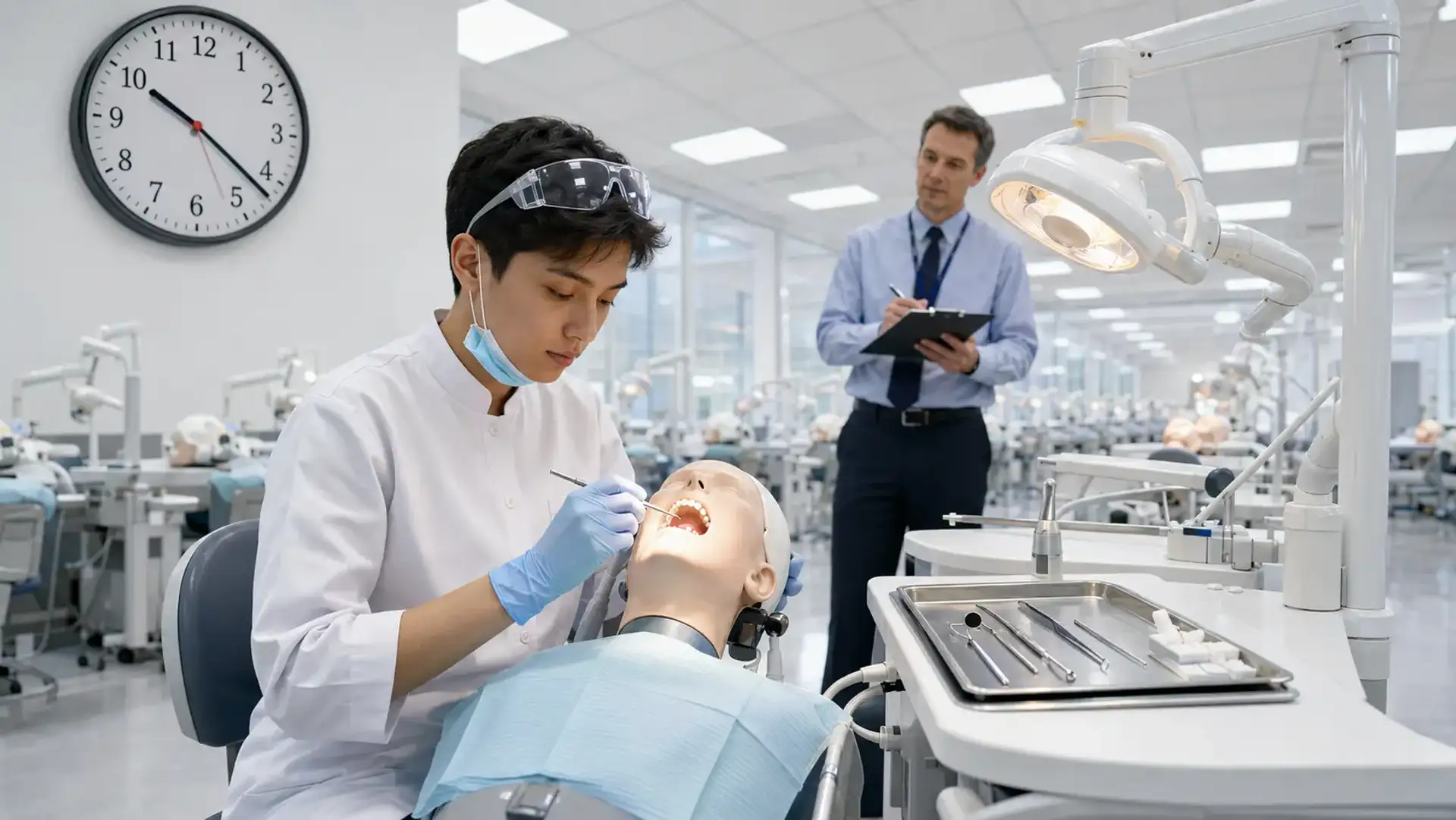
The practical examination runs over two days: a technical skills day, where you perform six procedural tasks on typodont teeth in a manikin, and a clinical skills day, run as a circuit of OSCE stations covering communication and clinical skills.
I encourage candidates to think of these as two separate exams that happen to share a certificate. They test different things, they are marked differently, and they punish different weaknesses.
The technical skills day
You arrive early — genuinely early, because the identity checks and registration run to a strict schedule, and late arrival is not a problem anyone can talk their way out of. You are assigned a position and briefed.
Then comes the moment the day really begins: you receive the task list. Every procedure for the day, with tooth numbers, surfaces, and a designated practice tooth. This is where nerves spike. Six tasks, fixed time, no negotiation.
The tasks are drawn from a published pool. Expect a mix along these lines — half preparation-based, half restoration-based:
- Approximal resin composite preparation
- Metal ceramic crown preparation
- Provisional crown restoration
- Resin composite restoration (anterior tooth)
- Endodontic access cavity
- Resin composite restoration (posterior tooth)
Nothing on that list frightens an experienced dentist. What makes the day hard is everything around the list.
The clock is the real examiner. Nearly every task on that list is comfortable without time pressure. With it, technique discipline is what separates a clean margin from a rushed one.
And there is no feedback. Nobody nods, nobody frowns, nobody tells you how you are doing. You submit each task and move on. The candidates who suffer most on this day are the ones who cannot stop re-litigating task three in their heads while task four slips away from them.
At the end of the day your work is collected and marked by calibrated examiners against standardised criteria. You go back to your hotel knowing nothing. Results arrive through ADC Connect roughly six weeks later.
The clinical skills day
The clinical day is a circuit. You rotate through OSCE stations on a fixed timer: read the scenario brief outside the station, plan for a couple of minutes, then the buzzer goes and you are in the room — often with a trained roleplayer and an examiner.
The communication scenarios cover the range of duties expected of a newly qualified dentist: taking a focused history, explaining a diagnosis and treatment options, obtaining informed consent, breaking bad news, managing an anxious or unhappy patient.
Three things reliably surprise unprepared candidates.
The roleplayers are good. They respond to what you actually say, not what you meant to say. Candidates who arrive with memorised speeches discover this in the worst possible way, usually when the “patient” asks a question the script did not anticipate.
Structure is scored. The examiners mark against defined criteria — clarity, empathy, structure, clinical accuracy. A warm but rambling consultation scores worse than a warm and structured one. Warmth alone is not a strategy.
The timer forgives nothing. If the buzzer goes with key elements of the consultation uncovered, there are no marks for what you were about to say.
The circuit format has one more sting: there is no recovery time. A station that goes badly is followed immediately by the next brief. Being able to genuinely reset between stations — to let the last one go — is a trainable skill, and candidates who have done full mock circuits have it. Candidates who have not, do not, and one bad station becomes three.
The week before
Keep it simple. Re-read the handbook and your examination correspondence. Confirm the venue, the reporting time, and exactly what you may bring. If you are travelling, arrive two or three days early — jet lag and a 7 am start are a poor combination. Do your final full-length mock at least a week out, then taper to light, precise practice. Plan your exam-day logistics down to the backup transport option.
The best exam day is a boring one
Everything in this article — the task-list moment, the unfamiliar equipment, the roleplayer curveballs, the between-station resets — can be experienced before exam day, in a setting where mistakes cost nothing and every one of them earns you feedback.
That is precisely what our mock exams are for: full exam-condition circuits for the Communication OSCE, skilled OSCE and technical skills, with individual feedback afterwards. The comment we hear most from successful candidates is that the real exam felt familiar. That is the whole point.
📧 info@lavanika.academy 📲 WhatsApp: +61468434447
Exam structure details are based on the ADC’s published examination materials, which are updated periodically. Your own examination correspondence and the official handbook at adc.org.au are the final word.
Frequently asked questions
What happens on the ADC practical examination days?
The practical examination runs across two different days: a Technical Skills Day of hands-on procedural tasks on typodonts, and a Clinical Skills Day of OSCE stations involving patient interaction. They test different abilities and are prepared for differently.
What should I bring to the ADC practical exam?
Follow the ADC's own instructions for your examination period, as the required and permitted items are specified there and can change. Check them again in the week before your exam rather than relying on what a previous candidate brought.
How should I prepare in the week before the exam?
Taper rather than cram. The week before is for rehearsing your routine, confirming logistics and sleeping properly — not for learning new techniques. In our experience the best exam day is a boring one, where nothing is a surprise because everything was decided in advance.
Do I pass or fail each day separately?
You must pass both the Technical Skills Day and the Clinical Skills Day to pass the practical examination. Strong performance on one day does not offset a failure on the other, so both need genuine preparation.
When do I get my practical examination results?
The ADC releases practical examination results via ADC Connect approximately six weeks after the examination date. Confirm current timeframes with the ADC, as processing times can change between periods.
Originally published · Reviewed and updated
Exam rules and requirements are set by the Australian Dental Council and can change. Always confirm current requirements on the ADC website before relying on any date or fee quoted here.